Categories
New Blog
Common Questions About Ceiling Speakers A Practical Guide for Modern Audio Projects
May 19 , 2026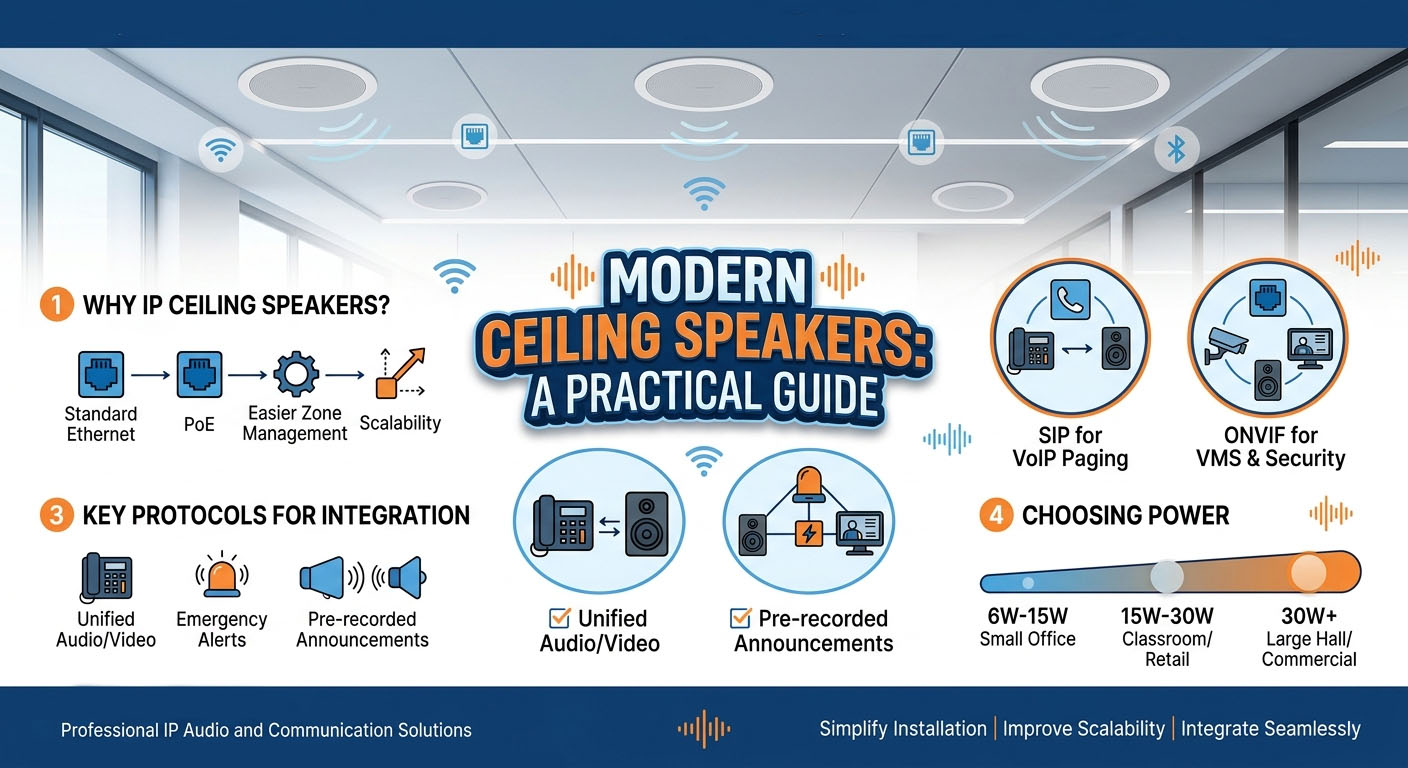
However, many customers still have questions before choosing the right solution. What is the difference between a traditional ceiling speaker and an IP Speaker? How much power is needed? Can the speaker work with a SIP system or security platform? And what role does ONVIF play in modern audio integration?
This article answers some of the most common questions about ceiling speakers while introducing how TONMIND network audio solutions are designed for today’s intelligent PA System environments.
A ceiling speaker is an audio device installed flush into a ceiling structure to provide distributed sound coverage. Compared with wall-mounted or horn speakers, ceiling speakers are more discreet and are ideal for indoor environments where aesthetics matter.
They are commonly used in:
● Offices
● Schools and universities
● Hotels
● Hospitals
● Shopping malls
● Conference rooms
● Airports
● Retail stores
Modern ceiling speakers are no longer limited to analog audio systems. With the development of network audio technology, IP-based ceiling speakers now provide far more flexibility and functionality.
Traditional analog speakers usually require centralized amplifiers, complicated wiring, and limited control options. In comparison, an IP Speaker operates directly over the network using standard Ethernet infrastructure.
TONMIND IP ceiling speakers are designed to simplify installation and system management while improving scalability for large projects. Through PoE technology, both power and audio data can be transmitted through a single network cable, reducing installation complexity and overall maintenance costs.
For modern buildings and smart facilities, this approach offers several advantages:
● Easier zone management
● Remote configuration and monitoring
● Flexible expansion
● Better audio quality
● Integration with existing network infrastructure
● Faster deployment for large-scale projects
SIP (Session Initiation Protocol) is widely used in VoIP communication systems. In audio broadcasting applications, SIP allows speakers to communicate directly with IP PBX systems, VoIP phones, and paging servers.
TONMIND ceiling speakers support standard SIP protocol compatibility, enabling users to perform live paging, emergency broadcasting, and two-way communication through existing network communication systems.
For example, in a school environment:
● Administrators can make announcements directly from a SIP phone
● Emergency alerts can be triggered instantly
● Different zones can receive different messages
● The system can integrate with existing communication infrastructure
This makes SIP-enabled speakers especially useful for campuses, factories, commercial buildings, and public safety projects.
Many customers associate ONVIF only with surveillance cameras, but it is now becoming increasingly important in professional network audio systems as well.
TONMIND speakers support ONVIF standards, allowing seamless integration with video management systems (VMS) and security platforms.
In practical applications, this means:
● Security operators can trigger live announcements from the monitoring center
● Audio warnings can be linked to camera events
● Pre-recorded messages can play automatically during alarms
● Audio devices can be managed directly through compatible VMS software
For integrated security and communication projects, ONVIF compatibility greatly improves interoperability between audio and video systems.
This depends on the speaker type.
Traditional passive ceiling speakers usually require an external amplifier. However, TONMIND IP ceiling speakers include a built-in amplifier, eliminating the need for additional amplification equipment in many installations.
This integrated design helps reduce:
● Equipment costs
● Rack space usage
● Wiring complexity
● Installation time
For contractors and system integrators, this can significantly simplify project deployment.
Speaker power selection depends on the installation environment and the expected sound coverage.
Typical recommendations include
|
Environment |
Suggested Power |
|
Small office / meeting room |
6W–15W |
|
Classroom / retail shop |
15W–30W |
|
Large hall / commercial area |
30W+ |
TONMIND offers multiple ceiling speaker configurations suitable for different commercial and industrial scenarios, allowing flexible deployment for both small and large-scale PA System projects.
Yes. In fact, many modern facilities use network ceiling speakers as part of their emergency communication infrastructure.
Because TONMIND IP audio products support SIP, ONVIF, alarm integration, and remote management, they can be incorporated into emergency notification systems for:
● Fire alarms
● Security alerts
● Evacuation instructions
● Scheduled announcements
● Public safety notifications
Combined with centralized management software, administrators can broadcast messages to specific zones or entire facilities in real time.
TONMIND focuses on professional IP audio and communication solutions for commercial and industrial applications. The company provides a wide range of products including:
● IP Ceiling Speakers
● SIP Horn Speakers
● Wall-Mounted IP Speakers
● Network Audio Systems
● Intercom Devices
● Paging Microphones
Many TONMIND products support both SIP and ONVIF protocols, making them compatible with VoIP systems and security platforms simultaneously.
The company also offers OEM/ODM customization services to meet different project requirements worldwide.
Ceiling speakers have evolved far beyond simple background music devices. In modern intelligent buildings, they now play an important role in communication, security, emergency response, and network broadcasting.
By combining IP Speaker technology with SIP communication and ONVIF integration, modern audio systems can become more flexible, scalable, and efficient than traditional analog solutions.
Whether you are designing a smart school, commercial building, transportation hub, or integrated security project, choosing the right network audio solution can make a major difference in long-term system performance and management efficiency.